
Introduction
When I worked for a supervising organization for Japan’s Technical Intern Training Program, I often conducted labor compliance audits.
One issue that frequently caused confusion was the difference between statutory holidays and company-designated holidays.
For example, I sometimes encountered work schedules where an employee had worked 12 consecutive days, raising the question:
“Is this actually legal under Japanese labor law?”
Even if you review an employment contract, it can be difficult to determine whether a work schedule complies with the law unless you understand the underlying legal rules.
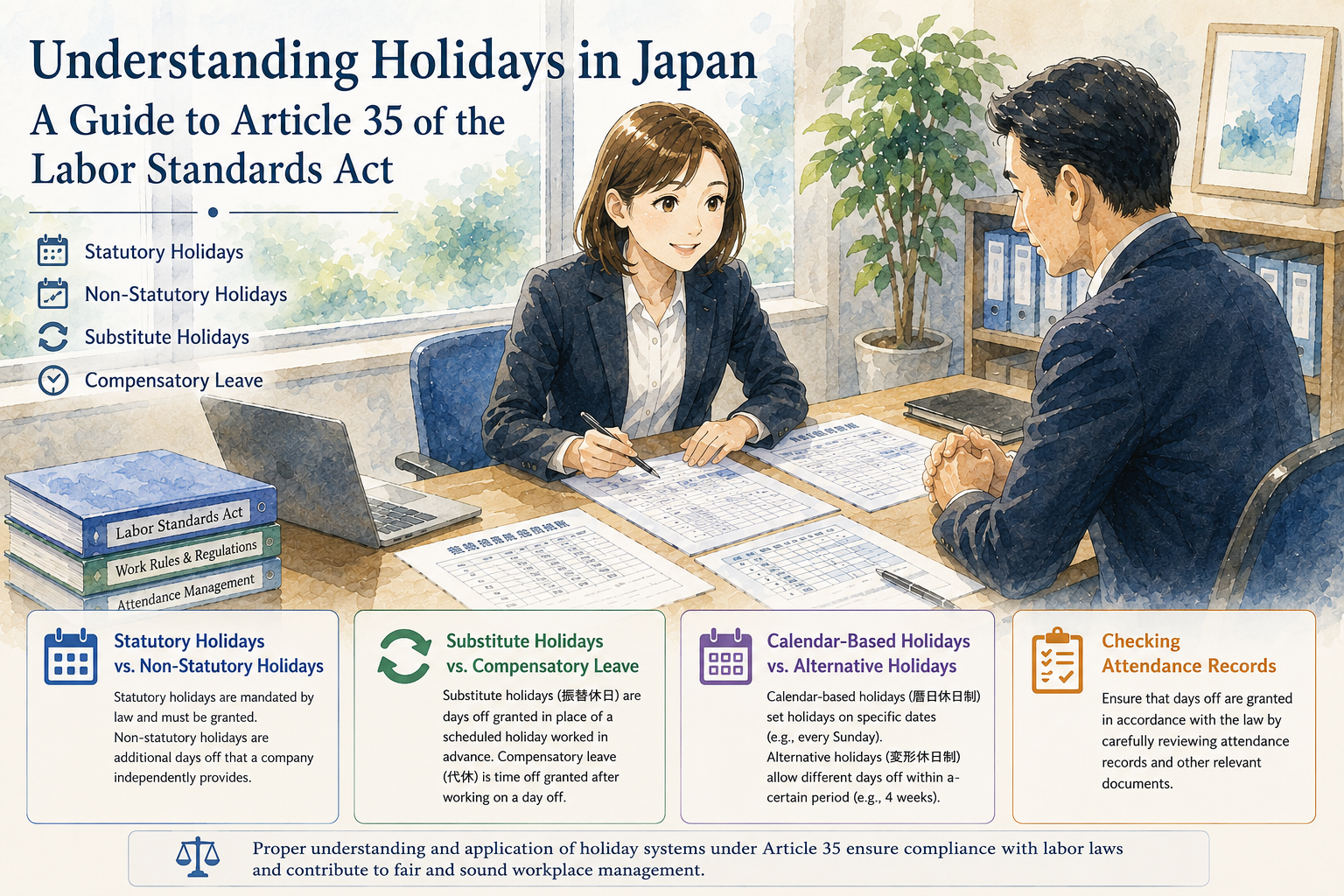
In this article, I will explain the concept of holidays under Article 35 of the Japanese Labor Standards Act, including the differences between statutory holidays, company-designated holidays, substitute holidays, and compensatory leave.
1. What Is an Employer’s Obligation to Grant Days Off?
Under the Japanese Labor Standards Act, an employer is generally required to provide employees with at least one statutory day off per week.
A day off (holiday) is a day on which an employee has no obligation to work under the employment contract.
As a general rule, a statutory holiday must consist of 24 consecutive hours, counted from 12:00 a.m. (midnight) to 12:00 a.m. of the following day (the calendar-day principle).
How a Statutory Holiday Is Determined under the Calendar-Day Principle
On the other hand, the Japanese Labor Standards Act provides an exception that allows employers to grant at least four statutory holidays within a four-week period, instead of one statutory holiday every week.
This exception is commonly referred to as the four-week holiday system.
As illustrated below, if an employer schedules all four holidays at the beginning of the first week and the remaining four holidays at the end of the eighth week, an employee could theoretically work 48 consecutive days (56 days minus 8 holidays).
Although this arrangement is legally permissible when the statutory requirements are satisfied, it can place a significant burden on employees.
Therefore, employers adopting this system should clearly specify the starting date of each four-week period in their Work Rules (or other internal regulations) and ensure that this information is properly communicated to all employees.
How a Statutory Holiday Is Determined (Calendar-Day Principle)
| 1st week | 2nd week | 3rd week | 4th week | 5th week | 6th week | 7th week | 8th week |
| Day off Day off Day off Day off | Day off Day off Day off Day off |
2. Statutory Holidays and Non-Statutory Holidays
As explained above, under the Japanese Labor Standards Act, an employer must provide each employee with at least one holiday per week, or alternatively, at least four holidays during each four-week period.
A holiday required under the Labor Standards Act is called a statutory holiday.
When an employee is required to work on a statutory holiday, this is referred to as statutory holiday work.
On the other hand, at a workplace that operates on a two-day weekend system, it is common for one of the two days off to be designated as the statutory holiday, while the other is treated as an additional holiday independently established by the company. This additional holiday is called a non-statutory holiday or company-designated holiday.
3. Difference Between a Substitute Holiday and Compensatory Leave
A substitute holiday is a system in which a day that was originally designated as a holiday is changed to a working day, while another day that was originally a working day is designated as the holiday instead.
In other words, the employer switches the holiday and the working day in advance.
To implement a valid substitute holiday, the following requirements should be satisfied.
Requirements for a Valid Substitute Holiday
- The company’s Work Rules (or other internal regulations) must contain provisions allowing holidays to be substituted.
- The substitute holiday must be designated in advance, before the employee works on the original holiday.
- The substitution must ensure that the employee still receives at least four statutory holidays within each four-week period, as required by the Labor Standards Act.
When a substitute holiday is properly implemented, statutory holiday work does not occur. Therefore, as a general rule, the employer is not required to pay the statutory holiday premium wage (at least 35%).
What Is Compensatory Leave?
Compensatory leave is different.
It refers to a system in which an employee first works on a holiday and is later given another day off as compensation for that holiday work.
In this case, the fact that the employee actually worked on the statutory holiday does not disappear. Therefore, if the work was performed on a statutory holiday, the employer must still pay the statutory holiday premium wage, even if compensatory leave is granted later.
Furthermore, under the Japanese Labor Standards Act:
- Employers are not legally required to grant compensatory leave after holiday work.
- Employees do not have a statutory right to request compensatory leave.
Conclusion
In this article, we have explained the differences between statutory holidays and non-statutory holidays, as well as substitute holidays and compensatory leave under the Japanese Labor Standards Act.
These concepts are often confused in daily business operations. However, understanding the differences is essential for ensuring proper labor management and legal compliance.
When employing foreign nationals in Japan, employers must comply not only with immigration laws and visa requirements but also with labor-related laws, including the Japanese Labor Standards Act. Proper compliance helps reduce legal risks and supports a fair and stable working environment.