A Practical Guide to Article 32 of the Japanese Labor Standards Act
Introduction
When employing foreign nationals in Japan, it is essential to understand the basic rules of Japanese labor law.
By understanding these rules, employers can reduce the risk of unintentionally violating labor regulations. Japanese labor law is complex, and even Japanese employers sometimes misunderstand how it should be applied.
In practice, interpretations may differ among supervisors, managers, and HR personnel. While consulting legal professionals is always advisable, we hope this article provides a useful overview of the fundamental concepts of working time under Japanese law.
1. Statutory Working Hours vs. Prescribed Working Hours
【Statutory Working Hours】
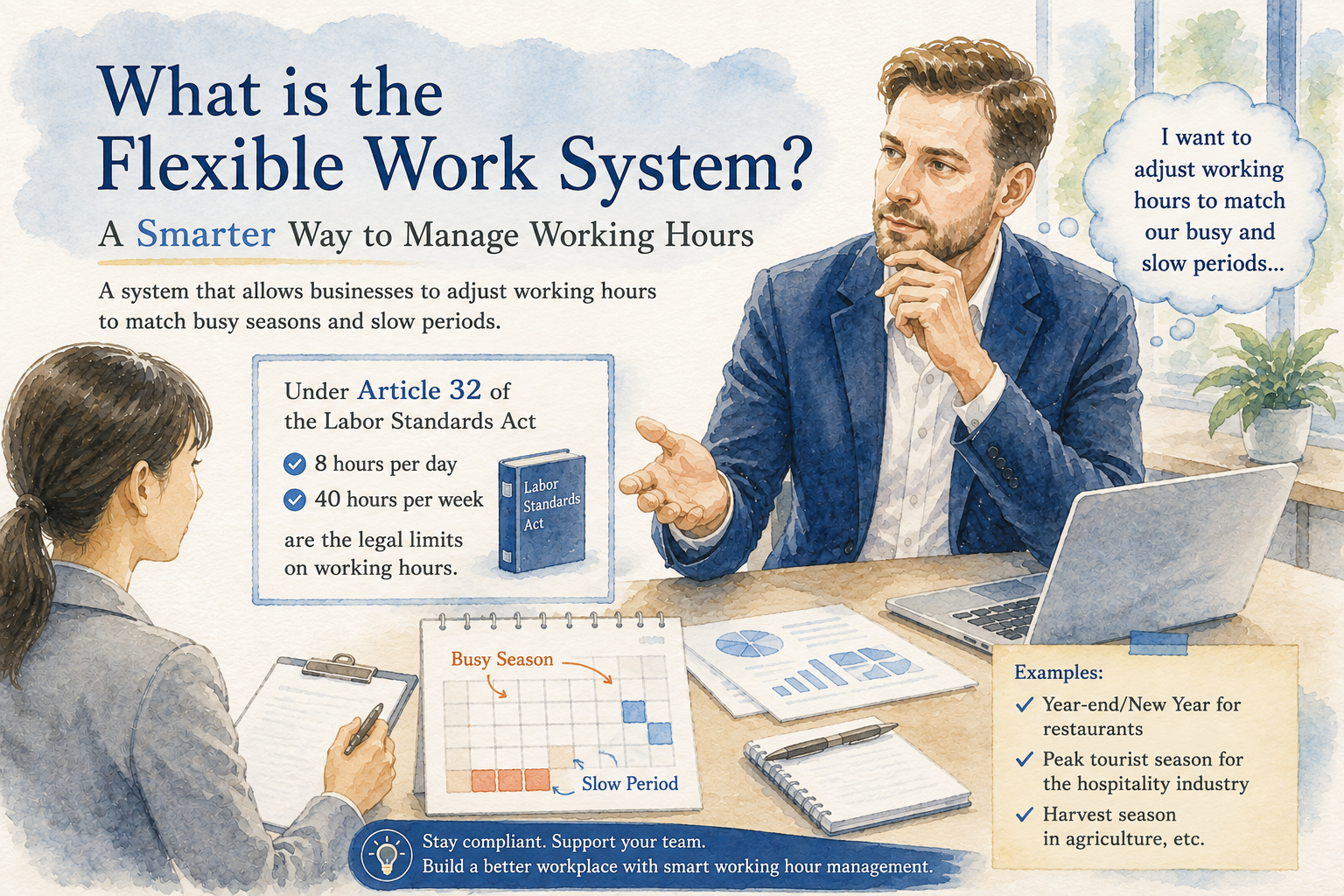
Under Article 32 of the Japanese Labor Standards Act, the statutory working hours are:
- 8 hours per day
- 40 hours per week
These are the basic legal limits on working hours in Japan.
【Prescribed Working Hours】
Prescribed working hours are the working hours established by each employer through:
- Employment contracts
- Work rules
- Labor-management agreements
provided that they remain within the statutory limits unless overtime procedures have been properly completed.
【Understanding Working Time and Rest Periods】
One Week
An employer may define the beginning and end of a workweek in its work rules.
If no rule exists, the calendar week (Sunday through Saturday) generally applies.
One Day
A “day” generally means the period from 12:00 a.m. to 12:00 midnight.
If a shift crosses midnight (for example, 6:00 p.m. to 5:00 a.m.), the entire shift is generally treated as belonging to the day on which work began.
Waiting Time
Waiting time refers to periods during which employees must remain available for work.
Examples include:
- Waiting to respond immediately to customers
- Waiting while assigned as the lunchtime telephone attendant
Such time is generally regarded as working time.
Rest Periods
A rest period is time during which employees are completely free from work obligations and may use the time as they wish.
【Key Factors in Determining Working Time】
Whether a particular period constitutes working time depends primarily on:
・The actual circumstances, rather than its label.
・Whether the employee was objectively under the employer’s direction and control.
Does This Count as Working Time?
Q1. Does sleeping during working hours count as working time?
It depends.
If the employee is completely released from the employer’s control, the time may not be regarded as working time.
However, if the employee must respond immediately to emergencies or remain on standby, the period is generally regarded as working time.
Q2. Is waiting during a lunch break to respond to visitors considered working time?
Yes.
If employees must remain available to respond immediately, they are not free to use their break as they wish.
In such cases, the waiting time constitutes working time, and another rest period should be provided.
Q3. Is attending employer-provided training considered working time?
It depends.
Voluntary training that employees may freely choose not to attend is generally not considered working time.
However, mandatory training or education required by the employer is regarded as working time.
Q4. When two truck drivers alternate driving, is the time spent sleeping in the passenger seat considered working time?
Yes.
Since the driver must remain available to resume driving when required, the sleeping time is generally treated as working time.
Q5. Is changing into a company uniform considered working time?
It depends.
If employees are required to change into uniforms at the workplace under the employer’s instructions, the changing time may constitute working time.
Q6. Is cleaning after work considered working time?
Yes.
If cleaning is required by the employer as part of the job, the time spent cleaning after regular working hours is regarded as working time.
2. Employer’s Obligations for Proper Working Time Management
Employers are required to accurately record employees’ working hours.
Working hours should generally be confirmed using:
- Time cards
- IC cards
- Computer login records
- Other objective records
If a self-reporting system is used, employers should:
- Explain the reporting procedures to employees.
- Verify the accuracy of reported hours.
- Conduct investigations when discrepancies arise.
- Correct inaccurate working time records where necessary.
Even during breaks or training, employers should confirm whether employees were actually under the employer’s direction and control.
3. Statutory Records and Employer Responsibilities
【Wage Ledger】
Employers must maintain a wage ledger recording:
- Working days
- Working hours
- Holiday work
- Overtime hours
- Late-night working hours
Intentionally recording false working hours may result in penalties under the Labor Standards Act.
【Statutory Employment Records】
Employers must retain documents such as:
- Employee roster
- Wage ledger
- Attendance records
- Time cards
These records must generally be retained for five years (currently three years during the transitional period).
4. Penalties for Violations of Working Time Regulations
If an employer requires employees to work beyond the statutory working hours, procedures such as concluding and filing a 36 Agreement (Overtime Agreement) must be completed.
Violations of these requirements may result in criminal penalties of:
- Imprisonment with work for up to six months, or
- A fine of up to JPY 300,000.
Some employers mistakenly believe that working beyond legal limits is acceptable if the employee agrees.
However, this is not the case.
The Japanese Labor Standards Act is designed to protect workers’ lives, health, and safety.
Even where an employee has agreed, employment conditions that fall below the legal minimum standards are not legally valid.
【Why Are the Penalties So Strict?】
Excessive working hours can lead to:
- Occupational accidents
- Traffic accidents
- Mental health issues
- Karoshi (death from overwork)
Illegal long working hours affect not only employees but also their families and the workplace as a whole.
For this reason, working time regulations are not merely company policies—they are minimum legal standards established to protect society.
Understanding Japanese labor law is an important first step toward compliant employment of foreign workers.
Knowing the law helps protect both your business and the people who work for you.