
Introduction
In our previous column, we introduced the four types of flexible working hour systems available under Japanese labor law.
One of these is the Flextime System.
In this article, we explain the procedures required to introduce a flextime system and its fundamental rules.
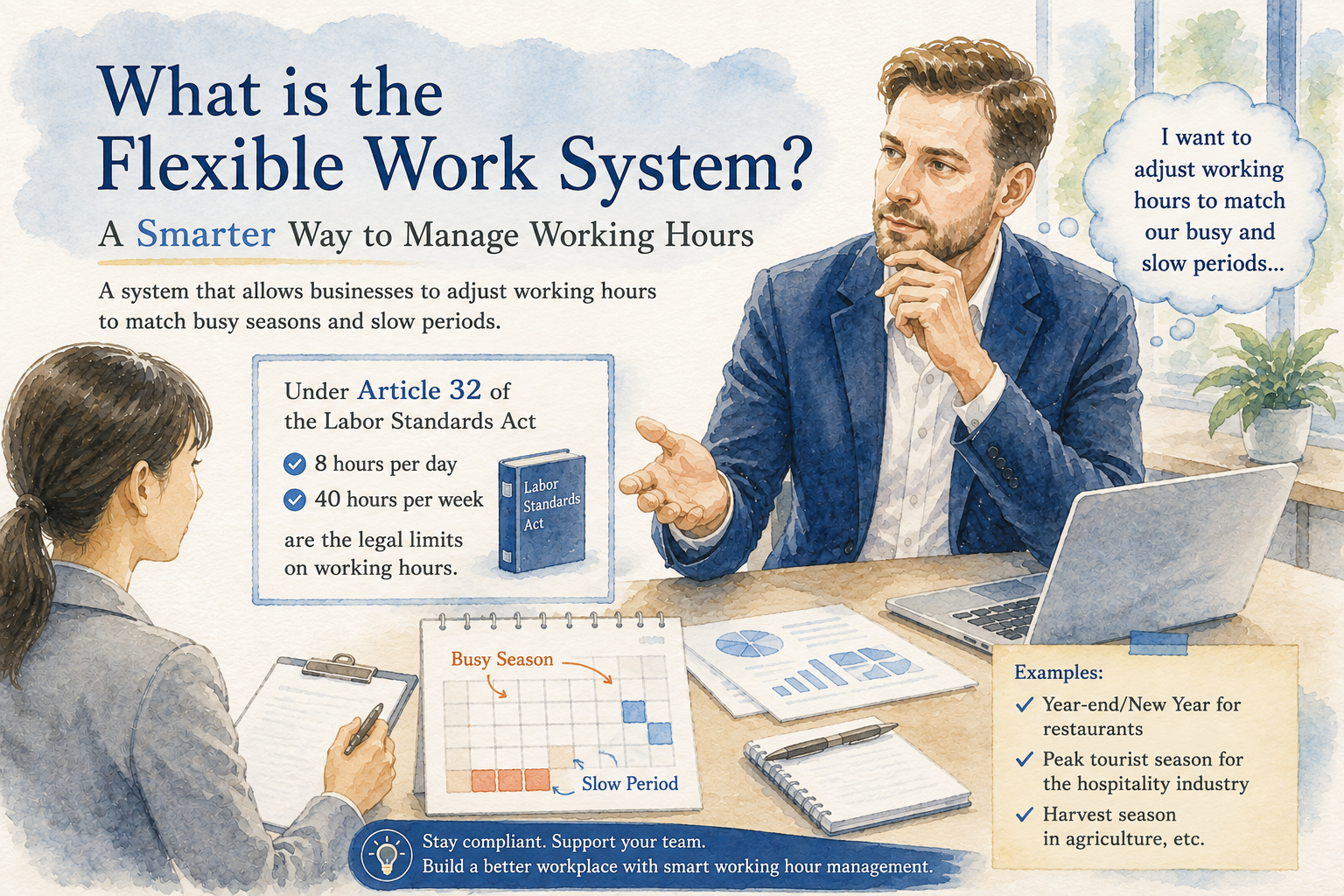
Please note that this article focuses on the statutory working hour system and flexible working hour arrangements under Article 32 of the Japanese Labor Standards Act.
The concepts of overtime work (Article 36 agreements) and overtime premium pay (Article 37) are separate legal issues and should be understood independently.
Overview of the Relevant Provisions of the Labor Standards Act
Chapter 4 – Working Hours, Breaks, Days Off, and Annual Paid Leave
- Article 32 – Statutory working hours and flexible working hour systems
- Article 33 – Emergency overtime work
- Article 34 – Break periods
- Article 35 – Weekly holidays
- Article 36 – Overtime and holiday work (the so-called “Article 36 Agreement”)
- Article 37 – Overtime, holiday, and late-night premium wages
- Article 38 – Calculation of working hours
- Article 39 – Annual paid leave
- Article 40 – Special provisions regarding working hours and breaks
1. Procedures for Introducing a Flextime System
A flextime system is one of the four flexible working hour systems recognized under Japanese labor law.
Introducing this system requires two separate steps.
Step 1 Establish the System in the Work Rules
The company’s Work Rules (or equivalent regulations) must provide that:
Employees are allowed to determine both their starting time and finishing time.
The important point is that employees must be able to decide both the beginning and the end of their working hours.
Step 2 Conclude a Labor-Management Agreement
The employer and either:
the employee representative, or the labor union must conclude a written labor-management agreement.
The agreement must include the following.
Mandatory Items
1.Employees covered by the system
2.Settlement period
3.Total working hours during the settlement period
4.Standard daily working hours
Optional Items
5.Core time
(the period during which employees must work)
6.Flexible time
(the period during which employees may freely choose when to start or finish work)
Although these items are optional under the law, establishing reasonable time bands generally makes the system easier to operate.
For example, defining flexible hours helps avoid late-night work issues, while a core time facilitates scheduling meetings and team collaboration.
2. Understanding the Settlement Period
Under a flextime system, working hours are adjusted over a designated settlement period.
The settlement period may be either:
(1)Up to one month, or
(2)More than one month but no longer than three months.
*The maximum settlement period permitted by law is three months.*
(1) Settlement Period of One Month or Less
This is the simpler option.
Features include:
- No need to specify the validity period of the labor-management agreement
- No filing with the Labor Standards Inspection Office
- Average weekly working hours during the settlement period must not exceed 40 hours
(2) Settlement Period Exceeding One Month (Maximum Three Months)
Additional requirements apply.
- The labor-management agreement must specify its effective period.
- The agreement must be filed with the Labor Standards Inspection Office.
- The average working hours for each one-month segment within the settlement period must not exceed 50 hours per week.
- The overall average for the entire settlement period must remain within 40 hours per week.
These additional rules were introduced in the 2019 amendment to help prevent excessive working hours.
3. Can Working Hours Be Carried Over to the Next Settlement Period?
This is one of the most important practical issues.
“Lending Hours”
Suppose an employee works more hours than scheduled during the current settlement period.
Can those extra hours simply be treated as fewer working hours in the next settlement period?
No. This is not permitted.
If employees could freely carry over excess working hours, part of the wages earned during the current settlement period would not be paid on the scheduled payday.
This would violate the principle of full payment of wages under Article 24 of the Labor Standards Act.
Allowing such carryovers could also create opportunities for employers to misuse the system to the disadvantage of employees.
“Borrowing Hours”
The opposite situation is treated differently.
If an employee works fewer hours than scheduled during the settlement period, the employer may still pay the employee’s full contractual wages.
The shortfall in working hours may then be carried over to the next settlement period.
This is allowed because the employee does not suffer a financial disadvantage, provided that the total statutory working hour limits are still observed.
However:
- the statutory working hour limits for the entire settlement period must still be satisfied; and
- where the settlement period exceeds one month, the average weekly working hours for each one-month segment must remain within 50 hours.
Example:
Suppose an employee is two hours short of the required working hours during the current settlement period.
The employer pays the employee’s full wages without deducting those two hours.
The employee then works those additional two hours during the next settlement period.
This adjustment is legally permissible.
Conclusion
In this article, we explained the procedures for introducing a flextime system and its basic legal framework.
In practice, employers should also pay attention to additional issues, including:
- Rules applicable to mid-period hires and resignations
- The employer’s obligation to accurately record working hours
- The relationship between flextime systems, overtime work, and premium wage calculations
A properly designed and well-managed flextime system can provide greater flexibility while ensuring compliance with Japanese labor law.